Most payment reminders are either too early to feel fair or too late to feel friendly. The sweet spot is not a secret. It is a simple rhythm that gives the other person a clear chance to pay before the reminder turns into a problem.
Here is the rhythm that works for friends, roommates, and clients.
Send the first reminder sooner than feels polite
If the payment was due Friday, sending a reminder on Saturday is not aggressive. It is accurate. The due date already set the expectation. A reminder simply confirms that the expectation is still open.
The mistake is waiting until you are annoyed. By then, the message has to carry two things: the payment request and your frustration. That is heavier than it needs to be.
A first reminder should be light and specific:
Hey, just a nudge that the $42 for the concert tickets was due yesterday. Could you send it today?
If the payment does not have a due date, create one before you need to chase. “Could you send it by next Wednesday?” gives the other person a real target and gives you a real reason to follow up.
Use a seven-day rhythm
For most informal debts, one week is enough time for a person to notice, remember, and act. It is also short enough that the debt does not disappear into the group chat.
A simple sequence looks like this:
- Before the due date: a friendly heads-up, optional.
- On the due date: a short reminder with the amount and a payment link.
- Two days later: one follow-up in case the first message got buried.
- One week later: a firmer, factual check-in.
- After that: stop improvising and decide what the relationship needs.
The exact spacing is less important than the principle: remind, wait, remind again, then change the channel or the conversation. Repeated messages with no new information feel like pressure. A clear next step feels like help.
Match the tone to the relationship
A reminder to a friend can be warm. A reminder to a client should be more formal. A reminder to a roommate should be boring in the best way.
For a friend:
Hey, bringing this back up in case it got buried. The $42 for the concert tickets is still open. Could you send it today?
For a client:
Hi, I have not received the October invoice payment yet. Could you confirm whether it is scheduled? The payment details are below if helpful.
For a roommate:
Rent is due Friday. Your share is $780. The transfer details are the same as last month.
The tone changes. The structure does not: context, amount, next step.
Do not send a reminder when you are angry
A reminder sent in anger usually contains more information than the other person needs. It explains how long you have been waiting, how many times you have asked, and what you think their silence means. That is not a payment reminder anymore. It is a case file.
If you notice yourself writing a long paragraph, stop. Wait an hour. Then reduce the message to the facts. You can always send a second message about the relationship later. You cannot unsend the one that made the debt feel like a character flaw.
Know when to stop reminding
There is a point where another reminder stops being useful. If someone has ignored three clear messages, the next step is not a fourth message with more exclamation marks. It is a different conversation.
Try one of these:
- Ask for a payment date instead of asking for payment again.
- Move the conversation to a call or an in-person chat.
- Offer a payment plan if that is appropriate.
- Decide whether the relationship or the client agreement needs to change.
For a client, follow the process in your contract. For a friend, decide what you are willing to do next before you send another message. A boundary is clearer than another nudge.
Make the reminder boring by design
The best reminder system is the one that does not depend on you remembering to be calm. Set the due date when you create the expense. Let the reminder go out on a predictable schedule. Keep the message short and useful.
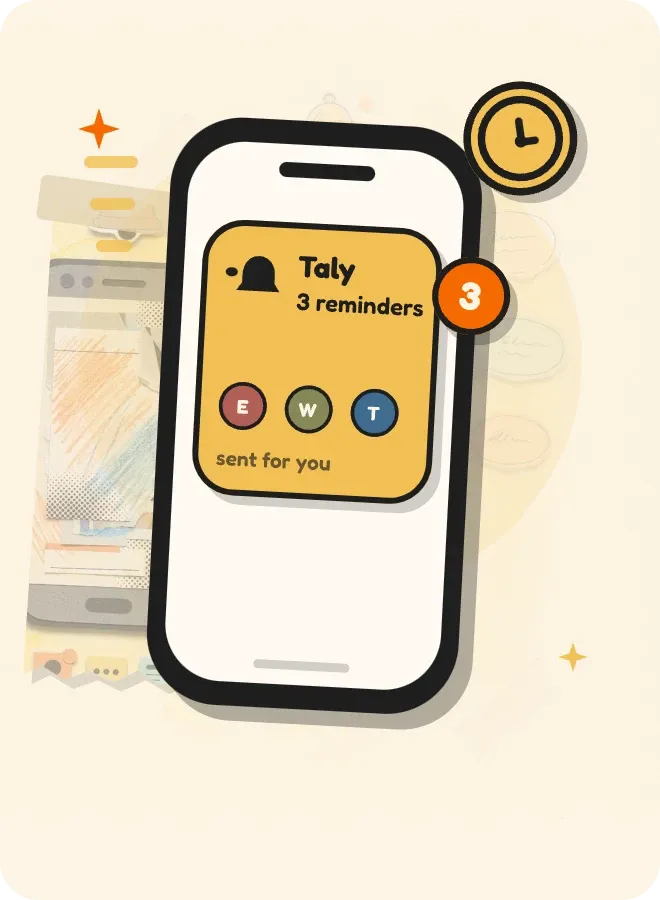
TalyPay groups reminders by person, so someone who owes you for dinner, rent, and a train ticket does not get three separate messages. They get one reminder that covers what is open, with the payment details attached. That is better for them, and much better for you.
The point is not to become a collections department. The point is to make asking routine enough that it stops taking up space in your head.